💡 Summary
The Apple Watch Ultra offers deep integration with Apple’s ecosystem, a vibrant display, and robust smartwatch features. Garmin devices, like the Fenix or Forerunner, excel in multi-sport tracking, extended battery life, and specialized outdoor navigation. Choosing between the Apple Watch Ultra vs Garmin hinges on prioritizing daily smart functionalities versus dedicated athletic and outdoor performance.
When considering high-performance wearables, the debate often centers on the Apple Watch Ultra vs Garmin. Both brands offer powerful devices for tracking activity, health metrics, and outdoor adventures, yet they cater to somewhat different user preferences. Making an informed choice between the Apple Watch Ultra vs Garmin requires understanding their core strengths and user experiences.
The Apple Watch Ultra presents Apple’s most robust smartwatch to date, designed for durability and deep integration within the iOS ecosystem. On the other hand, Garmin has a long-standing reputation for producing specialized GPS devices and sports watches, appealing to serious athletes and outdoor enthusiasts. We often find cases where users are torn, weighing the appeal of a full-featured smartwatch against the specialized capabilities of a sport-focused tool.
📑 Table of contents
Durability, Design, and Display: Apple Watch Ultra vs Garmin Build
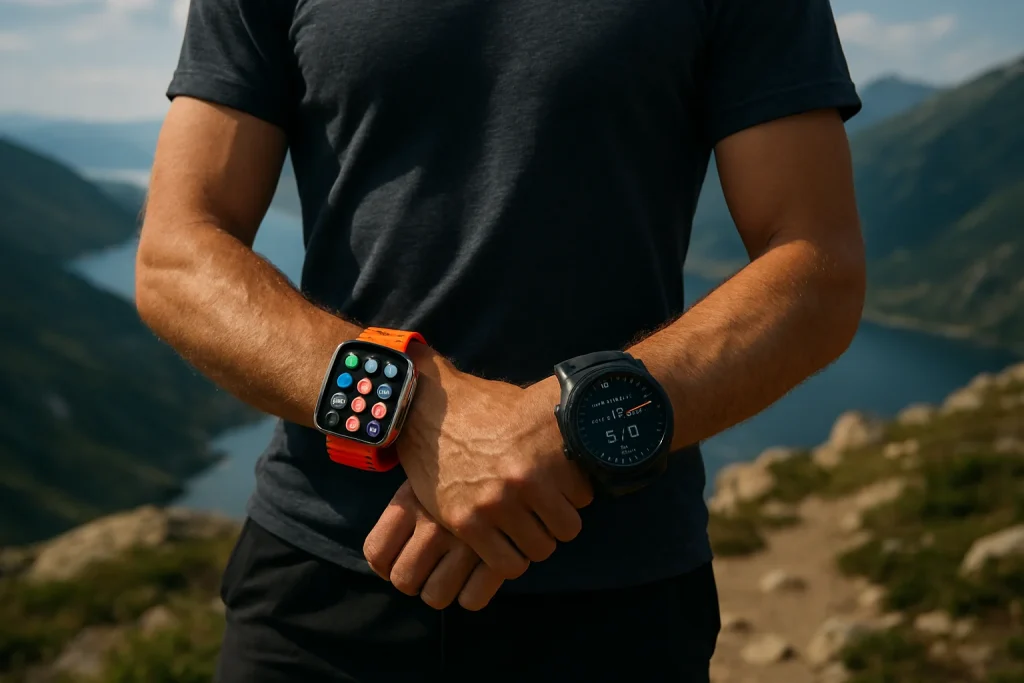
Comparing the physical attributes of the Apple Watch Ultra vs Garmin reveals distinct philosophies. The Apple Watch Ultra features a titanium case, a flat sapphire front crystal, and an Action Button for quick access to functions. Its Retina display is bright and always-on, providing excellent visibility in varied conditions.
Garmin offers a broader range of designs across its series (Fenix, Epix, Forerunner), often utilizing materials like stainless steel, titanium, and fiber-reinforced polymer. While some Garmin models, like the Epix series, feature vibrant AMOLED displays similar to the Ultra, many retain transflective MIP (Memory-In-Pixel) displays. These MIP displays consume less power and offer excellent readability in direct sunlight, albeit with less visual pop indoors.
Based on our experience, the build quality for both contenders is high, but they serve different aesthetic and functional goals. The Apple Watch Ultra leans into a modern, sleek-yet-rugged look, suitable for both daily wear and sport. Garmin’s aesthetic tends to be more utilitarian and purpose-built, particularly in its Fenix and Forerunner lines, which prioritize durability under extreme conditions.
Battery Life: A Significant Factor
Battery performance is often a deal-breaker for many users when comparing the Apple Watch Ultra vs Garmin. This is where Garmin typically holds a significant advantage, especially in its higher-end models.
Consider these approximate battery life metrics:
- Apple Watch Ultra:
- Up to 36 hours in typical use.
- Up to 60 hours in low-power mode.
- Up to 12 hours in specific GPS workouts.
- Garmin (e.g., Fenix 7 series, Forerunner 965):
- Smartwatch Mode: Weeks (e.g., Fenix 7 Pro Solar can offer 22 days, or up to 73 days with solar).
- GPS Mode: Days (e.g., Fenix 7 Pro Solar up to 73 hours, Forerunner 965 up to 31 hours).
This difference is substantial. For multi-day expeditions, ultra-marathons, or simply for users who dislike frequent charging, Garmin’s extended battery life offers peace of mind. The Apple Watch Ultra requires more regular charging, typically every one to two days depending on usage. For dedicated long-duration activities, the choice between Apple Watch Ultra vs Garmin often favors Garmin due to this extended endurance.
Fitness, Health, and Navigation: Core Competencies
Both device categories offer robust fitness and health tracking, but their approaches and depth differ.
Comprehensive Activity Tracking
The Apple Watch Ultra tracks a wide array of activities, from running and swimming to diving with its depth gauge and water temperature sensor. It features advanced heart rate monitoring, ECG capabilities, blood oxygen tracking, and temperature sensing for cycle tracking. Its built-in GPS is precise, and the compass functionality is reliable.
Garmin’s strength lies in its specialized metrics and extensive sport profiles. Devices like the Forerunner 965 or Fenix series provide advanced running dynamics, recovery metrics, training readiness scores, multi-sport profiles (triathlon, cycling, hiking, climbing), and detailed physiological measurements. Garmin’s GPS is renowned for its accuracy, especially in challenging environments, often supporting multi-band GNSS for enhanced precision. Many Garmin models also offer preloaded topographic maps, turn-by-turn navigation, and safety features.
Practical tips from our team indicate that for someone looking for granular data on specific athletic performance, recovery, and training load, Garmin often provides a deeper dive. For general health insights and daily activity monitoring with impressive accuracy, the Apple Watch Ultra performs exceptionally well.
Smartwatch Features and Ecosystem Integration
This is an area where the Apple Watch Ultra truly shines, leveraging the powerful Apple ecosystem.
The Apple Watch Ultra offers:
- Full cellular connectivity (independent of iPhone).
- Rich notifications, texting, and calls directly from the wrist.
- Access to a vast App Store for various utilities and third-party integrations.
- Apple Pay, Siri, and seamless integration with other Apple devices.
- Enhanced safety features like Crash Detection and international emergency calling.
Garmin devices, while offering smart notifications, music storage, and Garmin Pay, do not provide the same depth of cellular independence or the breadth of third-party apps found on the Apple Watch Ultra. Their primary function remains focused on sports and outdoor activity. The integration into Garmin Connect is robust for fitness data, but less expansive for general smart device functionality compared to the Apple Watch Ultra.
When deciding between Apple Watch Ultra vs Garmin, consider how much you rely on your wrist device for communication and convenience beyond tracking. For unparalleled smartwatch capabilities, the Apple Watch Ultra holds an advantage.
| Feature | Apple Watch Ultra | Garmin (e.g., Fenix/Forerunner) |
|---|---|---|
| Display Type | Always-On Retina (AMOLED) | AMOLED (Epix, 965) or Transflective MIP (Fenix, Forerunner) |
| Battery Life (Smartwatch Mode) | Up to 36 hours | Weeks (e.g., 22+ days, some with solar) |
| GPS Accuracy | Excellent (Dual-frequency GPS) | Excellent (Multi-band GNSS, often superior in challenging areas) |
| Cellular Connectivity | Yes (built-in) | No (requires phone tethering for calls/texts) |
| App Ecosystem | Vast App Store (iOS-dependent) | Garmin Connect IQ Store (focused on fitness) |
| Health Sensors | HR, ECG, Blood Oxygen, Temp, Depth Gauge | HR, Blood Oxygen, HRV, Training Readiness, Body Battery |
| Mapping | Basic maps, third-party apps | Preloaded Topo maps, turn-by-turn navigation |
| Target User | Apple users, general fitness, outdoor adventuring, deep smartwatch integration | Serious athletes, multi-sport, outdoor adventurers, long expeditions |
Target User and Value Proposition
The choice between the Apple Watch Ultra vs Garmin ultimately comes down to your primary use cases and preferences.
The Apple Watch Ultra appeals strongly to existing Apple users who desire a premium, durable smartwatch that seamlessly extends their iPhone experience. It excels as a daily driver for health monitoring, communication, and general fitness tracking, while offering respectable capabilities for many outdoor pursuits, including recreational diving. It blends advanced health sensing with top-tier smartwatch functionality. Learn more about the underlying technology of these devices by checking out the Smartwatch Wikipedia page.
Garmin devices, particularly models like the Fenix and Forerunner series, are geared towards athletes and adventurers who prioritize specialized training metrics, extended battery life, and robust navigation tools. If you are an ultra-runner, a serious hiker, a triathlete, or someone who spends days away from charging points, Garmin’s ecosystem and hardware are built for you. The emphasis is on performance data, durability, and sustained operation rather than broad smartwatch capabilities.
In considering the Apple Watch Ultra vs Garmin, think about what drives your activity. Are you a recreational enthusiast who enjoys connected living, or a dedicated athlete demanding precise, long-lasting performance data? Both platforms offer compelling devices, but their focus areas differ significantly, impacting the overall user experience.
FAQ
Which has better battery life, Apple Watch Ultra or Garmin?
Garmin devices generally offer significantly longer battery life, often lasting weeks in smartwatch mode and days with GPS, compared to the Apple Watch Ultra’s typical 36 hours.
Is the Apple Watch Ultra suitable for serious athletes?
Yes, the Apple Watch Ultra offers advanced tracking and durability suitable for many athletes, including runners, swimmers, and divers. However, Garmin often provides deeper, specialized metrics for highly specific training.
Can Garmin watches make calls without a phone?
Most Garmin watches do not have standalone cellular connectivity for calls and texts. They typically require a connected smartphone for such features, unlike the cellular-enabled Apple Watch Ultra.
Which offers better mapping capabilities?
Many Garmin models (like the Fenix and Epix series) come with preloaded topographic maps and advanced navigation features, offering a more robust mapping experience than the Apple Watch Ultra’s standard maps.
What is the main advantage of the Apple Watch Ultra over Garmin?
The main advantage of the Apple Watch Ultra is its deep integration with the Apple ecosystem, full cellular connectivity, and extensive third-party app support, making it a more comprehensive smartwatch.
Is the Apple Watch Ultra as durable as Garmin’s rugged watches?
The Apple Watch Ultra features a titanium case and sapphire front crystal, making it very durable. Garmin offers many rugged models designed for extreme conditions, with some having similar or even greater shock resistance depending on the specific model.
Are health tracking features similar on both devices?
Both offer robust health tracking (heart rate, blood oxygen). The Apple Watch Ultra adds ECG and wrist temperature sensing. Garmin focuses more on recovery, training readiness, and body battery metrics, offering detailed physiological insights for athletes.
